
Celebrating Leadership: Kerstin Haskell Receives the 2025 Diane Fleming Leadership Award
November 6, 2025
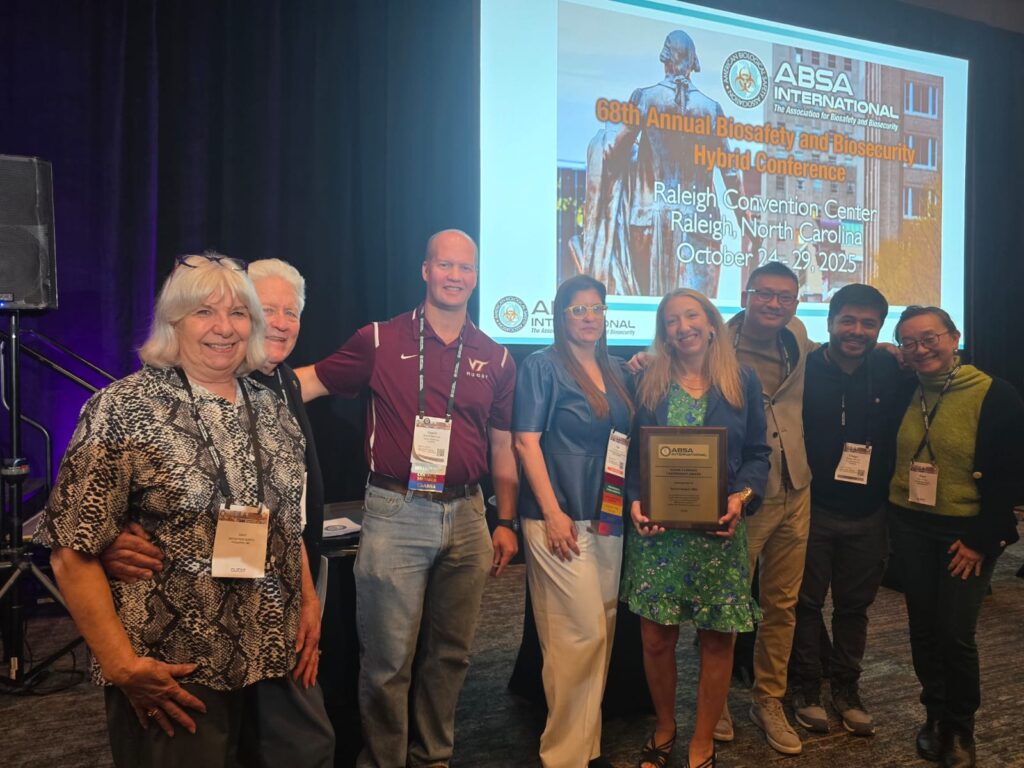
Leadership in the biosafety and biosecurity community is more than a title—it’s a commitment to mentoring, collaboration, and advancing the profession. Each year, ABSA International honors an individual who exemplify these values through the Diane Fleming Leadership Award. In 2025, that honor goes to World BioHazTec’s President: Kerstin Haskell.
Why Kerstin?
Kerstin embodies the spirit of Diane Fleming through visionary leadership, cross-sector collaboration, and a dedication to strengthening the biosafety profession. As President of the Chesapeake Area Biological Safety Association (ChABSA) from 2024 to 2025, Kerstin reinvigorated the organization—inspiring membership, motivating council, and establishing a sustainable operational model.
Her leadership didn’t stop there. Kerstin forged partnerships with organizations previously unengaged with biosafety, demonstrating her ability to translate biosafety’s value to broader audiences. One of her most notable achievements? Securing a gubernatorial proclamation from Maryland Governor Wes Moore, declaring June 4, 2025, as Biosafety Day—a first-of-its-kind recognition at the state level.
This milestone required persistent outreach and collaboration with key stakeholders, including the Maryland Department of Commerce, the Maryland Tech Council, and the Universities at Shady Grove. Kerstin’s ability to communicate biosafety’s impact in ways that resonate with decision-makers was instrumental in making this happen.
A Leader Who Inspires
Kerstin’s leadership style fosters trust, collaboration, and genuine connection. She creates an environment where members feel valued and engaged—bringing not only professionalism but also a sense of fun to meetings. Her approach reflects the core values of ABSA International and the Diane Fleming Award: service, collaboration, and impact.
Quote to Remember
“Serving on an ABSA International affiliate leadership team is not a burden—it’s an honor. Yes, the work is real, but it is absolutely possible to do this work with joy, humor, and a sense of purpose.” — Kerstin Haskell
Acknowledging the Team
In her acceptance remarks, Kerstin emphasized that leadership is never the work of one person. She credited the ChABSA Council for their dedication and contributions:
- Tracey Brown, Treasurer – Integrity and accountability
- Matt Fischer, Secretary – Clarity and continuity
- Bruce Donato – Attention to detail for symposium success
- Ron McNeil – Fresh energy and ideas as a first-year counselor
- Jamie Pope, David Harbourt, Sharon Altmann – Innovative technical programs and academic partnerships
- Elizabeth Bramhall, Current President – Dynamic speaker scheduling and networking opportunities
Together, they created a culture of learning, laughter, and trust—proving that leadership can be both impactful and joyful.
Congratulations, Kerstin!
This award is a testament to what servant leadership can accomplish. Kerstin’s achievements inspire all of us to lead with vision, collaboration, and heart.
Featured Posts
Why Properly Sealed Electrical Receptacles Matter in BSL-3 Laboratories
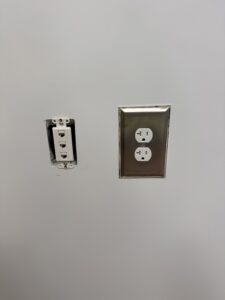
In high-containment laboratories, significant attention is often given to HVAC systems, pressure relationships, HEPA filtration, and room finishes. However, containment integrity can be compromised by something as simple as an improperly sealed electrical receptacle. In Biosafety Level 3 (BSL-3) laboratories, every penetration of the containment envelope—including electrical electrical devices (boxes, switches, receptacles, lights, signal systems, telecommunication, data systems etc.—must be designed and installed to maintain airtightness and support effective decontamination and cleanability. This article focuses on electrical receptacles, as they present the fundamental challenges that all electrical systems, including low-voltage installations, must address to preserve a fully sealed containment envelope. Small Openings Can Create Big Problems BSL-3 laboratories rely on a sealed containment envelope to prevent the release of potentially hazardous biological materials and to ensure decontamination processes function as intended. Any penetration through walls, ceilings, or other containment boundaries can become a leakage path if not properly sealed. Electrical boxes are among the most common penetrations found throughout a laboratory, making their proper installation particularly important. Even small gaps around electrical boxes, conduits, or faceplates can create pathways for airflow leakage or allow decontamination gases and vapors to escape containment areas. Not All Electrical Boxes Are Created Equal Two common electrical box types are used in containment facilities: Cast Boxes Cast electrical boxes provide inherent sealing advantages due to their factory-formed, solid construction. When installed with properly fitted conduit connections, they offer a robust containment solution. Stamped Metal Boxes Stamped metal boxes can also be successfully used in BSL-3 environments, provided they are properly sealed. The exterior of the box and conduit connections must be treated with appropriate sealing materials to achieve the same level of airtightness expected from cast boxes. The key consideration is not the box type itself, but whether the installation achieves and maintains containment integrity. Sealing boxes in the field can be a quality control issue and can be time consuming. Conduit Connections Are Often Overlooked One of the most common hidden leakage pathways is the conduit-to-box interface. Air and decontamination chemicals can travel through the conduit system if proper sealing measures are not implemented. At the conduit-to-box interface, containment can be maintained by sealing the conduit at the box using either a 25 mm (1-inch) depth of ASTM C920-compliant silicone caulk, applied into the conduit opening and around the conductors, or by installing listed seal-tight conduit fittings that provide equivalent protection. Installation Quality Matters Containment performance is heavily influenced by workmanship. Penetrations should be cut as close as possible to the electrical box dimensions, minimizing void spaces around the installation. Any remaining gap—typically maintained at approximately 1/8 inch—should be sealed with approved caulk and finished with a smooth, durable surface. Proper caulking helps maintain an airtight boundary while providing a surface that can withstand routine cleaning and decontamination activities. The NIH Design Requirements Manual (DRM) Appendix L Sealant Table serves as a good reference for caulk selection. Properly executed seals serve multiple purposes: Maintain containment integrity Eliminate leakage pathways Improve cleanability Support long-term durability of the installation Cleanability Is a Biosafety Requirement A well-sealed installation is not only about airtightness. Biosafety facilities must be designed to facilitate routine cleaning and decontamination. Faceplates should fit flush against receptacles, data jacks, switches, and other devices. A continuous bead of approved caulk around the perimeter of the faceplate eliminates cracks and crevices where contamination might accumulate and prevents leakage through the device opening. The finished seal should be smooth, durable, and compatible with facility cleaning and decontamination procedures. Gaskets should not protrude beyond the edge of the faceplate. This attention to detail helps support both day-to-day operations and emergency response activities. Supporting Safe Decontamination Perhaps the most important reason to properly seal electrical penetrations is their role during laboratory decontamination. Unsealed electrical boxes and conduit pathways may allow decontamination chemicals to escape the laboratory, reducing treatment effectiveness and potentially exposing personnel or building occupants outside the containment area. Proper sealing helps ensure decontamination agents remain within the target space for the required exposure period. In this way, receptacle sealing contributes directly to both: Effective facility decontamination Protection of personnel and adjacent building occupants Verification Is Essential Even when installations appear satisfactory, verification should be performed when containment integrity is questioned or during certification activities. Common evaluation methods include: Thermal imaging Smoke testing Bubble testing Pressure Pan testing These techniques can help identify leakage pathways that may not be visible during routine inspections. Conclusion Electrical receptacles including the many electrical devices that penetrate the containment envelope may seem like a minor detail within a complex BSL-3 laboratory, but they play an important role in maintaining containment integrity. Properly sealed electrical devices —including the use of approved caulking materials—help prevent leakage, support effective decontamination, improve cleanability, and protect both laboratory personnel and building occupants. In high-containment facilities, biosafety is often measured by attention to the smallest details. A properly sealed receptacle is more than good workmanship—it is an essential component of a comprehensive containment strategy. True containment is achieved not through major systems alone, but through meticulous attention to every detail—including a single electrical receptacle. World BioHazTec helps organizations around the world evaluate, verify, and strengthen the engineering and biosafety systems that protect personnel, research, and the environment. Contact us today to learn how we can help strengthen your facility's containment strategy.
Read More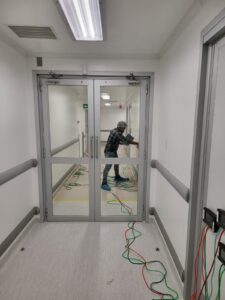
Why Independent Certification Strengthens Biosafety Programs
Across the world, many laboratories rely on in-house certification programs often supported by building management systems (BMS) and internal maintenance teams to meet annual compliance requirements. While these approaches can satisfy baseline regulatory expectations, they may not always deliver the level of assurance needed in today’s increasingly complex biosafety environment. As laboratories evolve to support advanced research, biomanufacturing, and high-consequence pathogen work, there is a growing case for incorporating independent, third-party certification into routine practice. The Limitations of In-House Certification In-house certification programs offer convenience and cost control, but they also present inherent limitations: Potential bias and conflict of interest Internal teams are often responsible for both maintaining and verifying system performance. This can unintentionally create blind spots or reduce critical scrutiny. Overreliance on Building Management Systems BMS platforms are valuable tools but they are not designed to provide comprehensive certification. They typically monitor trends rather than validate performance under test conditions. A system may appear stable in the BMS, yet fail to meet containment or airflow requirements when independently tested. Limited diagnostic depth Internal checks often confirm that equipment is “functioning,” but may not assess whether it is operating optimally, especially under stress, failure scenarios, or edge conditions. Why Third-Party Certification Matters Engaging an independent certifier introduces a higher level of rigor, objectivity, and technical depth. True Independence and Objectivity Effective biosafety depends on the interaction of facility systems, administrative controls, maintenance practices, and laboratory operations. Independent reviewers evaluate these elements as an integrated system rather than assessing individual components in isolation. A third-party certifier has no stake in the facility’s operations, maintenance contracts, or internal performance metrics. This independence ensures: Unbiased evaluation Transparent reporting Identification of issues that internal teams may overlook This is especially critical in environments where safety margins are thin and consequences are high. Verification Beyond the BMS While a BMS provides continuous monitoring, certification requires active testing. Third-party certification includes: Direct measurement using calibrated, independent instrumentation Verification of airflow, pressure differentials, and containment performance Challenge testing to confirm system integrity under real-world conditions This approach moves beyond “data observation” and into performance validation. Engineering-Level Interpretation Data alone does not equal insight. Third-party certification brings: Engineering interpretation of results Contextual understanding of system design and intent Identification of systemic issues rather than isolated failures Third-party reviewers evaluate not only whether systems meet current performance criteria, but also whether they continue to operate in accordance with the facility's original design intent. For example: A pressure cascade may meet minimum thresholds, but fluctuate in a way that compromises containment Air change rates may appear compliant but fail to support effective contaminant dilution These nuances are often only recognized when data is interpreted by experienced biocontainment engineers. Independent Review of Administrative Controls Engineering controls are only one component of an effective biosafety program. Administrative procedures—including risk assessments, standard operating procedures, training programs, incident response processes, and documentation systems—play an equally important role in maintaining safety and compliance. An external reviewer brings a fresh, objective perspective that internal personnel may not be able to provide. Over time, organizations can become accustomed to long-standing practices and assumptions, making it difficult to identify procedural gaps, inefficiencies, or areas where written policies no longer reflect actual laboratory operations. Laboratories also evolve over time through personnel turnover, equipment upgrades, procedural revisions, and changing research activities. Periodic independent reviews help ensure that administrative controls continue to align with current operations and biosafety risks. A third-party review can: Evaluate whether administrative controls align with current biosafety risks Identify gaps between documented procedures and day-to-day practices Assess the effectiveness of training and competency programs Review documentation, recordkeeping, and corrective action processes Provide benchmarking against industry best practices and peer facilities This independent perspective often uncovers opportunities for improvement that may be overlooked during routine internal reviews, helping laboratories strengthen both their biosafety culture and overall operational effectiveness. Alignment with Evolving Global Expectations Across the world, regulatory frameworks emphasize risk management, traceability, and demonstrable control but often allow flexibility in how certification is achieved. By incorporating third-party certification, laboratories can: Strengthen compliance posture beyond minimum requirements Demonstrate due diligence to regulators and stakeholders Align with international best practices This is particularly relevant for facilities engaged in: Cross-border collaborations Pharmaceutical manufacturing High-containment (BSL-3/4) operations Raising the Standard, Not Just Meeting It In-house certification frequently focuses on confirming that systems meet predefined limits. Third-party certification, by contrast, asks a deeper question: Is the system performing at the level required to ensure safety and reliability? This shift in perspective leads to: Early identification of degradation trends Validation of corrective actions and continuous improvement initiatives Improved system resilience Enhanced protection for personnel, products, and the environment Effective biosafety depends on the interaction of engineering controls, administrative procedures, maintenance programs, and laboratory practices. Independent certification evaluates these elements as an integrated system rather than as isolated components. A Complementary Approach It’s important to note that third-party certification is not a replacement for internal programs—it is a critical complement. The most effective laboratories combine: Continuous monitoring via BMS Routine internal operational and administrative reviews Periodic independent certification of engineering controls and administrative programs This layered approach provides both operational continuity and objective validation. Conclusion As the global bioscience landscape continues to advance, so too must the standards that underpin laboratory safety and performance. Relying solely on in-house certification and building management systems may no longer be sufficient to meet the demands of modern research and production environments. By incorporating third-party certification, laboratories gain not only compliance assurance—but a deeper understanding of how their facilities, administrative controls, and laboratory practices work together to support biosafety. Ultimately, independent certification is not just about checking a box—it’s about achieving a higher standard of biosafety. Ready to have your lab certified? Contact us for a free consultation.
Read More
What This Award Represents—and Why Biosafety Matters
By: Kerstin Haskell, MBA. President, World BioHazTec. I remember exactly where I was when I got the call. I was sitting in an airport, waiting for my flight home from Iceland after attending a conference in Germany. I was exhausted, jet-lagged, and only half paying attention to my phone when it rang. “Check your email!” said Carol Traum, our Executive Vice President. “Congratulations!” said Ted Traum, our Principal. “What are you talking about?” I asked. I was tired. “The award! You got it!” “Wait,” I said, suddenly more awake. “I’m going to meet the Governor?” That was the moment I learned I had been selected to receive the World Trade Center Institute Maryland International Business Leadership Award. It Started with a Conversation, Not a Campaign Like most meaningful recognition, this did not begin with a campaign or an application package. It started with a phone call from Brian Castleberry at the Maryland Department of Commerce—an exceptional partner who had helped bring Biosafety Day to Maryland the year before. He asked a few straightforward questions about our exports that year. “I’m putting you in for an award,” he said. “Oh, okay,” I replied, and rattled off some numbers. At the time, it didn’t feel momentous. In hindsight, it was one of those quiet inflection points that leadership careers are built on. Showing Up as a Team When the interview invitation arrived, the timing could not have been better. Dan Yoong, World BioHazTec’s Managing Director for Asia, the Middle East, and Africa, was already in the U.S. preparing for the ABSA International Conference. There was no question—Dan needed to be part of that interview. If we were being asked to speak about global impact, public health, and international collaboration, then he was a living example of that work. His wife joined us as well, as we were driving straight from the interview in Baltimore to Raleigh, North Carolina, for the conference. I will never forget that room—nearly fifteen people gathered around a conference table, introducing themselves. When it was Dan’s wife’s turn, she smiled and said, “I’m the boss of him,” pointing directly at Dan. The room immediately burst into laughter. Any nervousness disappeared. From there, we spoke openly and proudly about biosafety, engineering, partnership, and what it takes to build a company that crosses borders while remaining deeply rooted in Maryland. A Night That Felt Bigger Than One Person The awards ceremony at the M&T Bank Exchange was unforgettable. The room glowed with dramatic purple and blue hues, and for a moment, everything felt quietly surreal. Sitting to my left was my mentor, RADM Deborah Wilson, PhD, CBSP, RBP (ret.), with her husband, Tom, by her side. On my right was my husband, Jake. At our table were my parents, Ted and Carol Traum, long-time leaders and partners in World BioHazTec, alongside COO Juan Osorio and his wife Nathalie, and Lia Vizzotti, CEO of World BioHazTec Latin America. As I looked around the room, what struck me most was the scale. There were nearly 400 people in attendance—leaders from business, government, academia, and industry. Many of them had likely never heard the word biosafety before that evening. And yet, the work represented in that room—and far beyond it—depends on it. That realization stayed with me. Biosafety should not be a niche term known only to scientists and engineers. It should be recognized and embraced by C-suite executives, policymakers, investors, and institutional leaders as a foundational element of responsible innovation, public health preparedness, and economic resilience. If biosafety is invisible, it is vulnerable. If it is understood, it becomes integrated into decision-making at the highest levels. That sense of responsibility made the night feel larger than any single recognition. The People Who Brought Us Here That feeling deepened as women approached me throughout the evening—congratulating me, thanking me, and noting that I was the only woman among the six award recipients that year. Each time, I proudly introduced them to RADM Wilson and shared just how instrumental she has been in bringing so many of us together. From Ted’s early brainstorming sessions with RADM Wilson, to Juan Osorio—whom we met through colleagues in RADM Wilson’s orbit who recognized both his talent and the growing need for leadership in biocontainment engineering—to Lia Vizzotti, whom we met during a WHO-supported training session RADM Wilson helped organize, the throughline was RADM Wilson. She had an extraordinary ability to see what was needed and to connect people at exactly the right moment. We never forget that. Seeing Our Story on the Screen I will admit, I was nervous when the program began introducing each honoree and playing short videos about their work. I didn’t know what to expect when World BioHazTec appeared on the screen. You can watch the video here. What I saw was emotional, grounded, and deeply reflective of what our team has built over decades. When the video ended and I stood, the applause was immense—and humbling. A Conversation with the Governor When I met Governor Wes Moore, I thanked him for issuing Maryland’s Biosafety Day Proclamation—and, admittedly, asked whether we might be able to have another one. I asked him to connect me with his team so we could talk more about biosafety, its economic impact, and why Maryland is uniquely positioned as a global hub for high- and maximum-containment laboratories. We are a dense, interconnected community doing work that matters far beyond our borders. He was gracious, engaged, and genuinely curious. After confirming it was allowed, my husband stepped up to the stage. As we stood with Governor Wes Moore, he handed his phone to a woman nearby and asked, “Would you mind taking our picture?” I quickly interjected, “Jake, she is probably the CEO of some big company.” She laughed and replied, “Actually, I am the CEO of BWI Airport,” and graciously took our photo with the Governor. What This Award Represents This award is an honor—but more importantly, it is a responsibility. It reflects the collective work of World BioHazTec’s global team, the mentors who shaped us, the partners who trusted us, and Maryland’s leadership in biosafety and public health. The work continues, and we are proud to carry it forward—together. My hope is that leaders across industry, government, and policy will engage with biosafety not as a compliance obligation, but as a strategic responsibility that protects people, strengthens innovation, and safeguards our collective future.
Read More